
Humpback whales in Cornwall
We spoke to Cornwall Wildlife Trust Marine Conservation Officer, Rebecca Allen, to find out what's drawing these gentle giants to our shores, and how we can help protect them.
Read more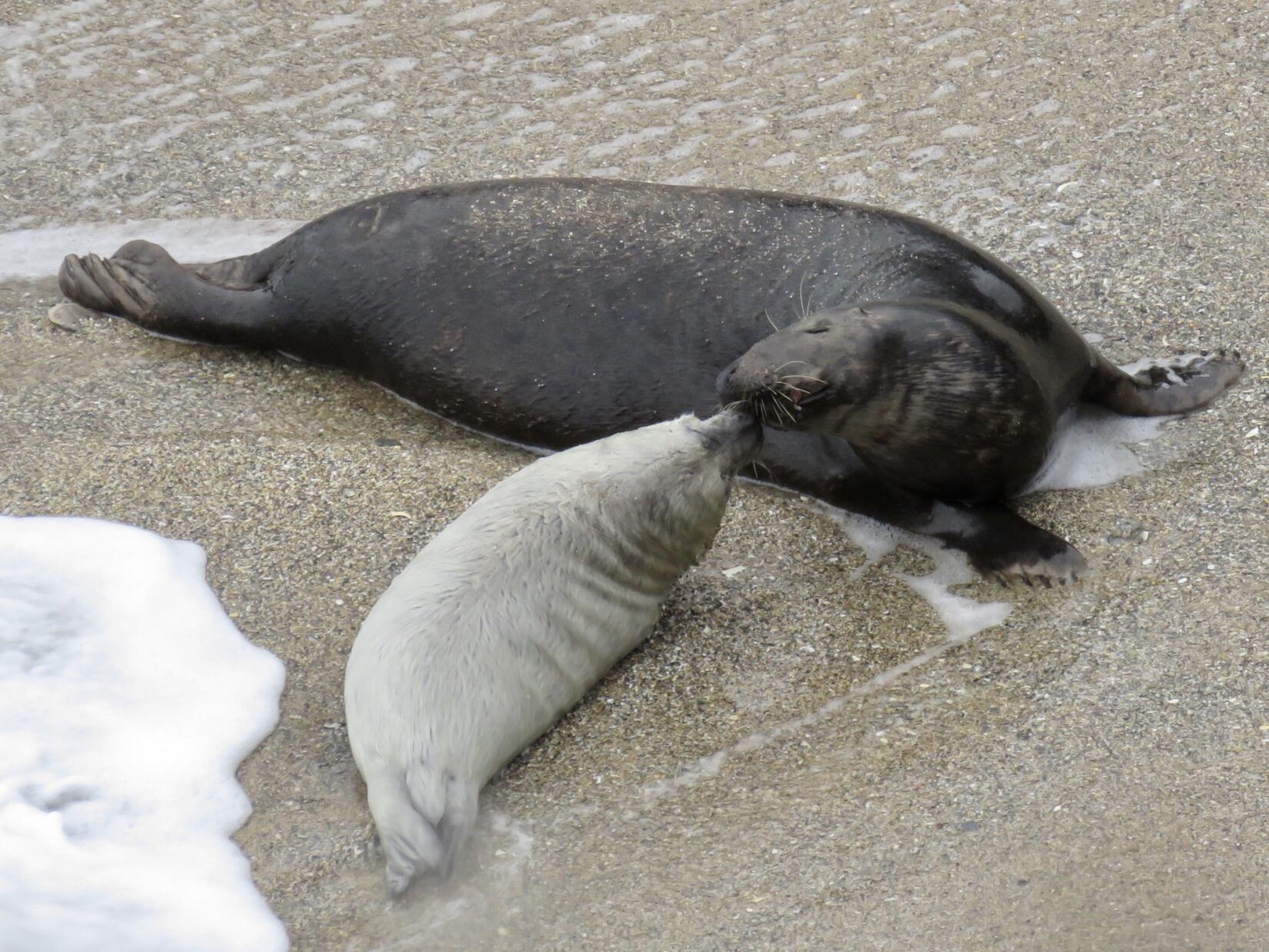
Along the Cornish coast, wildlife is never far away, and sometimes you’ll be lucky enough to spot it. A whale breaching, a seal just beyond the break, a pup resting on the rocks. So what should you do when you come across marine life up close?
As part of our conservation work, two marine mammal medics, Lizzi Larbalestier and our very own Julie Hull, share expert insights into Cornwall’s grey seals, and the small actions that can help keep them (and you) safe.
"As beach and water lovers, we’re only ever visitors here," reflects Lizzi. "A little space, a little awareness – it can make all the difference."
Give them space.
Keep it quiet.
If in doubt, call BDMLR on 01825 765546.
(BDMLR are the British Divers Marine Life Rescue, who run a 24/7 rescue hotline)
If you spot a seal or pup on the shore.
Keep your distance – around 100m if possible – and encourage others to do the same. If they’re looking at you, you’re too close. If you'd like to take photos, use a zoom lens.
Keep voices quiet.
If you have a dog, put it on a lead. This is for both the seal and your dog's safety – seals have a hard bite, and carry diseases that can spread to humans.
And avoid sharing locations on socials as more visitors means more disturbance.
"Pups often come ashore to rest while their mums feed, particularly during winter storms. Intervening will often do more harm than good," explains Lizzi.
If you come across a seal whilst in the sea.
Seals are curious so they may come over to take a look. If they do, just move slowly away.
Keeping your distance helps them stay wild, and reduces risks from boats, nets and other human interactions.
Seals spend a lot of time resting both in the water and on land. It’s essential for digestion, recovery and survival.
If disturbed on land, they can panic and injure themselves. Or return to the ocean without enough energy.
"For pups, the impact is even greater. Human disturbance is the number one reason un-weaned pups become separated from their mums, often leading to malnourishment."
If you come across an injured seal or pup.
If you see a lone young pup (fluffy white coat) with no mum in sight.
Or if something just doesn't seem right.
"If in doubt, call. You're never wasting BDMLR’s time", says Lizzi. "By calling in a pup in trouble you’re reducing its suffering and potentially saving its life."
Waiting for a medic to attend is a huge help, but if you have to leave, calling the BDMLR hotline with a what 3 words location and a photo (taken from a distance) gives the seal or pup a fighting chance of getting help.
And, as Lizzi explains, a few everyday choices can also make a big difference in protecting seals, and other marine life...
Avoid flying ring frisbees near the coast as they can become caught around seals’ necks.
Take a moment for a mini beach clean, and particularly focus on nets. The fine monofilament net is one of the most common nets seals get entangled in. Even the shortest length poses a real threat.
Think about the wider impact of what you buy on climate change – stormier winters during pup season are already affecting survival.
For Julie Hull, part of the Watergate Bay team, spreading this advice is deeply personal.
"I’ve always been an animal-lover and coming to work at Watergate Bay naturally extended this to marine life." But a sad incident at the Bay was the catalyst for Julie's marine mammal medic training.
"A few winters ago, a beach-goer at the Bay returned a seal pup to the water. No doubt trying to help but, unfortunately, doing the opposite. When the marine mammal medics arrived they explained that, if you see a pup on the beach during winter months – pup season – they’re most likely exhausted and in need of rest." Sadly, that was the case for this pup and it didn’t survive.
"I wanted to know what to do if that happened again, and bring that knowledge back to the hotel."
Julie used one of Watergate Bay’s volunteer “You Days” to train with BDMLR, bringing that knowledge back to the Bay.
“I spent the day on the beach in Bideford with brilliant instructors and volunteers, where we learned how to keep both seals, and ourselves, safe.”
Julie has now been a fully qualified marine mammal medic for two years, and the impact can be seen across the Bay – from rescues to removing ring frisbees from the shop, conversations with guests to children’s activities.
If we teach children staying at the hotel what to do, they’ll talk to their parents, and friends, so one person knowing becomes ten people.
Julie’s also inspired others to train. Her daughter is on the BDMLR course list, and a colleague in kids' zone is interested in becoming a medic. And, covering the full stretch of the UK coastline, with a 24/7 emergency service, the BDMLR needs all the volunteer medics it can get.
You might spot Julie walking the Bay before or after a shift, scanning the beach and rocks for seals and pups.
And if you do make that call to BDMLR, it might even be Julie, or Lizzi, responding.
Lizzi Larbalestier is an advanced marine mammal medic and instructor with BDMLR. Before the construction of the BDMLR Cornwall seal hospital, Lizzi’s own home became a temporary one, caring for 139 sick and injured seals.
Julie Hull is our Reception Manager and a qualified marine mammal medic with BDMLR, bringing her training into daily life at the Bay.
Seal images credit: Lizzi Larbalestier
We spoke to Cornwall Wildlife Trust Marine Conservation Officer, Rebecca Allen, to find out what's drawing these gentle giants to our shores, and how we can help protect them.
Read moreCornwall Wildlife Trust introduces us to some of the visitors you might spot in our waters and along our coastline.
Read moreFind out what to expect at Watergate Bay's far north end
Read moreWe spoke to local ecologist and lecturer John Blackburn to learn more about our local Jackdaw colony- from facial recognition, to high level showing off.
Read moreThe waters off the Cornish coast provide a home for thousands of species, here's our guide on where to find them.
Read moreWe'd love to keep in touch and send you the latest news, events, competitions and offers from the Bay. Sign up to receive our e-newsletter.